Abandoned village
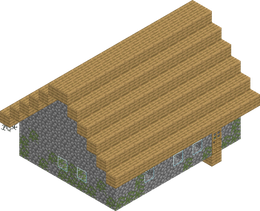
extra_large_2| Type | Jigsaw structure |
|---|---|
| Biomes | Plains, Sunflower Plains, Desert, Savanna, Snowy Plains, Taiga, Old Growth Pine Taiga, Old Growth Spruce Taiga |
| Generates in | Overworld surface |
| Consists of | Oak planks, cobblestone, mossy cobblestone, glass, gravel, suspicious gravel |
| Added in | 0.6-alpha |
| Resource location | minecraft:village_plains, village_desert, village_savanna, village_snowy, village_taiga |
An abandoned village is the pack's replacement for the vanilla village. Every village generates as a small cluster of empty, overgrown houses around a well, with no villagers, no job site blocks and no loot chests. The houses' gravel floors contain suspicious gravel that can be brushed for loot.
The developer's intent is that "the minecraft world should feel abandoned until YOU come along": villagers belong at the player's base, which should feel alive, but the rest of the world should not.[1] Villagers are obtained instead through Asylum Seeker applications (see Villager).
Generation
The five vanilla village structures are kept, but all of them now use the same abandoned "village_beta" pieces, whatever the biome.[2]
| Structure | Biomes |
|---|---|
village_plains |
Plains, Sunflower Plains |
village_desert |
Desert |
village_savanna |
Savanna |
village_snowy |
Snowy Plains |
village_taiga |
Taiga, Old Growth Pine Taiga, Old Growth Spruce Taiga |
Each structure lists its biomes directly instead of using the vanilla has_structure biome tags. Compared with vanilla, villages no longer generate in Meadows, and taiga villages can also generate in Old Growth Pine and Old Growth Spruce Taigas and plains villages in Sunflower Plains.
The minecraft:villages structure set uses a random spread with a spacing of 80 chunks and a separation of 50 chunks, compared with 34 and 8 in vanilla, making villages much rarer.[3] Abbeys cannot generate within 16 chunks of a village.
Each village is a jigsaw structure with a maximum depth of 5 pieces and a maximum distance of 116 blocks from its center, using beard_box terrain adaptation.
Structure
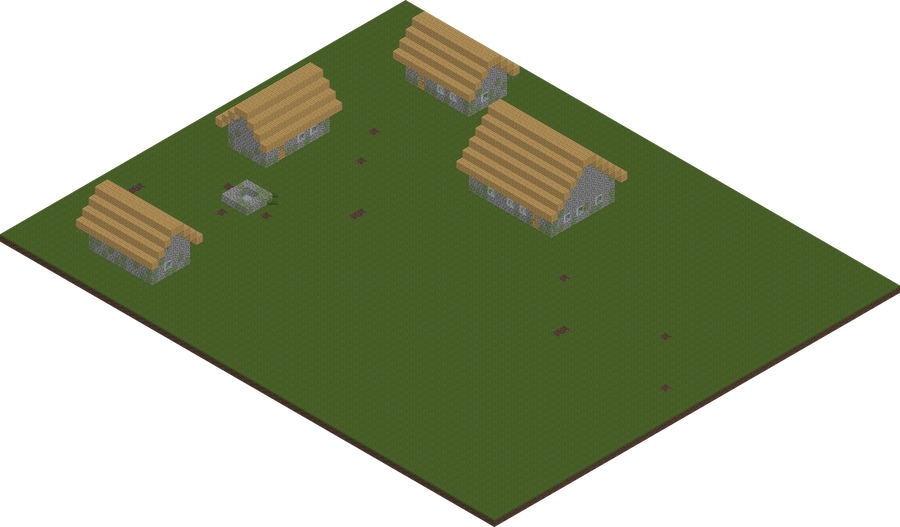
- Well (6 × 9 × 6): the start piece, built from cobblestone and mossy cobblestone around water. A gravity processor sinks it 8 blocks relative to the surface. Roads branch out from its four sides.[4]
- Roads: invisible connector pieces with no blocks of their own, except that some of their connectors turn into a single coarse dirt block. They are chosen from end (weight 3), straight (2), T-junction (1) and L-junction (1). Straight and end pieces have a connector for a house.[5][6]
- Houses, chosen from the
village_beta/buildingspool:[7]
| House | Weight | Size | Suspicious gravel | Notes |
|---|---|---|---|---|
| small_1 | 1 | 12 × 8 × 8 | 3 | |
| medium_1 | 2 | 14 × 8 × 10 | 4 | |
| medium_2 | 3 | 14 × 8 × 10 | 3 | |
| large_1 | 2 | 12 × 9 × 10 | 6 | |
| extra_large_1 | 4 | 15 × 10 × 14 | 8 | A chest containing one Cyan Rose. |
| extra_large_2 | 5 | 15 × 10 × 14 | 8 | |
| extra_large_3 | 2 | 15 × 10 × 14 | 8 | |
| extra_large_4 | 1 | 15 × 11 × 13 | 1 | The inhabited house. |
| extra_large_5 | 4 | 18 × 10 × 13 | 8 |
-
 well
-
 small_1
-
 medium_1
-
 medium_2
-
 large_1
-
 extra_large_1
-
extra_large_2
-
 extra_large_3
-
 extra_large_4
-
 extra_large_5
All houses are built from oak planks, cobblestone and mossy cobblestone with glass windows and an oak door, and are decorated with cobwebs and pale hanging moss. Two unused templates, indev_normal and indev_mossy, are in the pack but are not in any pool.
Loot
Archaeology
Suspicious gravel in village houses uses archaeology/village_plains:
Loot table minecraft:archaeology/village_plains (source); pools roll 1 time(s).
| Item | Stack size | Chance per roll | Chance per table | Notes |
|---|---|---|---|---|
 Obol |
1 | 15.8% | 15.8% | |
 Iron Ingot |
1 | 15.8% | 15.8% | |
 Poppy |
1 | 15.8% | 15.8% | |
 Straw |
1 | 15.8% | 15.8% | |
 Heart Pottery Sherd |
1 | 10.5% | 10.5% | |
 Howl Pottery Sherd |
1 | 10.5% | 10.5% | |
 Friend Pottery Sherd |
1 | 10.5% | 10.5% | |
 Clay Fetish (Rejoice) |
1 | 2.63% | 2.63% | |
| Clay Fetish (Lament) |
1 | 2.63% | 2.63% |
Chests
Village houses have no loot-table chests, so the pack's versions of the vanilla village chest loot tables (chests/village/*) are not used. Since 1.12.6-alpha those tables are empty anyway; see Chest loot#Village.
Maps
The Wandering Trader sells maps to abandoned villages, named "Abandoned Plains Village Map", "Abandoned Desert Village Map" and so on. See Explorer maps.
The inhabited house
One house, extra_large_4, is different. Its floor has only one block of suspicious gravel. Inside are torches, a crafting table, two chests, a jukebox, a hopper, a redstone block, and a mannequin tagged haunted that uses the skin entity/player/wide/him.[8] The resource pack draws that skin as an all-black silhouette.[9] The house has a weight of 1 out of 24 in the house pool.
The chests contain:
- 3 Diamonds, 6 Hematite, 11 Coal, 14 cobblestone and a damaged wooden pickaxe.
- 3 old-style porkchops, 6 dirt, 3 Roses, an oak door, 3 oak planks and 1 mossy cobblestone. These porkchops are unstackable, restore no hunger, can always be eaten, are eaten in 0.1 seconds and give Regeneration III for 1.8 seconds, like food in old versions of Minecraft.
The hopper holds a music disc of Dry Hands by C418, locked by the redstone block beside it.
Behavior


The scene runs every tick for each player who is inside any village structure (the #minecraft:village structure tag); outside a village, nothing in the house happens.[10][11][12]
- All background music is stopped for a player inside a village, whatever their game mode.[11]
- The nearest haunted mannequin turns to face the nearest player.[13]
- A marker entity tagged
jukeboxstands at the redstone block, about 2 blocks from the jukebox. When a survival player comes within 30 blocks of this marker, the redstone block is removed. The hopper unlocks and pushes Dry Hands into the jukebox, which starts playing. The marker then counts down aLifetimescore of 2 and, a few ticks later, removes the hopper and itself, so the music plays only once per house.[14] - The mannequin vanishes (it is teleported 1000 blocks down) when a survival player comes within 5 blocks of it or within 2 blocks of the jukebox marker,[13] or opens an oak door while within 11 blocks of it. The oak door check uses the hidden advancement
matcha:mechanics/opened_oak_door, which works in any village or outside one.[15][16]
Eerie sounds
Players in a village also hear sounds that seem to come from nowhere. A 150-second stopwatch restarts continuously; shortly after each restart, and again 100 seconds in, a player hears a sound that depends on the block they are standing on:[17][18]
| Standing on | Sounds |
|---|---|
| Coarse dirt | Four wooden footsteps passing overhead, 4 blocks above the player. |
| Oak planks | Grass breaking 5 blocks to the side (twice), and a cave ambience sound. |
| Gravel | Gravel breaking 3 blocks below, then later a stone block being placed. |
| Suspicious gravel | A wooden door opening 3 blocks behind the player. |
| Grass block | Grass breaking 4 blocks below, followed by four stone blocks being placed beneath the player. |
Because the stopwatch only matches for a fraction of a second, whether a player hears the sound depends on tick timing; the code notes that this "makes it kinda random".
History
| 0.6-alpha July 17, 2026 |
Villages replaced with abandoned villages ("Villages! But not what you would expect").
|
|---|---|
| 1.10 August 10, 2026 |
Removed the old village predicates (in_village_on_oak_*).
|
| 1.12.8-beta October 23, 2026 |
Changed what triggers the inhabited house's secret: its scripts now run only while a player is inside a village, and one distance is now measured from a different point. Removed the hidden advancement matcha:mechanics/enter_village and the eerie score.
|
Trivia
- The pieces are named "village_beta", and the inhabited house's porkchops, roses and cyan rose use "classic" models, a reference to early versions of Minecraft.
- The developer wants "all structures given the villager treatment", including redone pillager towers; see Papal Outpost.
- Players often reported the missing villages as a bug. The developer explained that villages encourage players to move into a base built for them instead of building their own, and make the world feel smaller because they exist to be traded with and raided. The developer's first village, found before trading existed, made the world feel bigger because its inhabitants lived apart from the player.[19] Villages were at first removed entirely, and brought back as abandoned villages as a last-minute change meant to recall the horror of old versions of Minecraft.[20]
See also
References
- ↑ Matcha Flavoured 0.6-alpha release notes: "I think the minecraft world should feel abandoned until YOU come along, so villagers at your base makes sense, it should feel alive. But the rest of the world shouldn't"
- ↑
structure/village plains.json - ↑
structure set/villages.json - ↑
village beta/town centers.json - ↑
village beta/roads.json - ↑
roads/end.nbt - ↑
village beta/buildings.json - ↑
buildings/extra large 4.nbt - ↑
wide/him.png - ↑
timers/tick.mcfunction - ↑ 11.0 11.1
village/tick.mcfunction - ↑
predicate/in village.json - ↑ 13.0 13.1
village/entity.mcfunction - ↑
village/jukebox.mcfunction - ↑
village/check if entity should die.mcfunction - ↑
mechanics/opened oak door.json - ↑
function/stopwatches.mcfunction - ↑
village/eerie sound.mcfunction - ↑ Klei Wright, "How Criticism changed Matcha Flavoured" (YouTube): "I think villages incentivize the player to instead of building a house to find somewhere else to live to have the house built for them"
- ↑ Klei Wright, "How Criticism changed Matcha Flavoured" (YouTube): "I originally got rid of villages entirely. I I made it so that um they didn't even spawn at all, but as a last minute thing"

| Pack structures | |
|---|---|
| Changed structures | |
| Terrain |
|
| Loot | |
| Mechanics |
|